
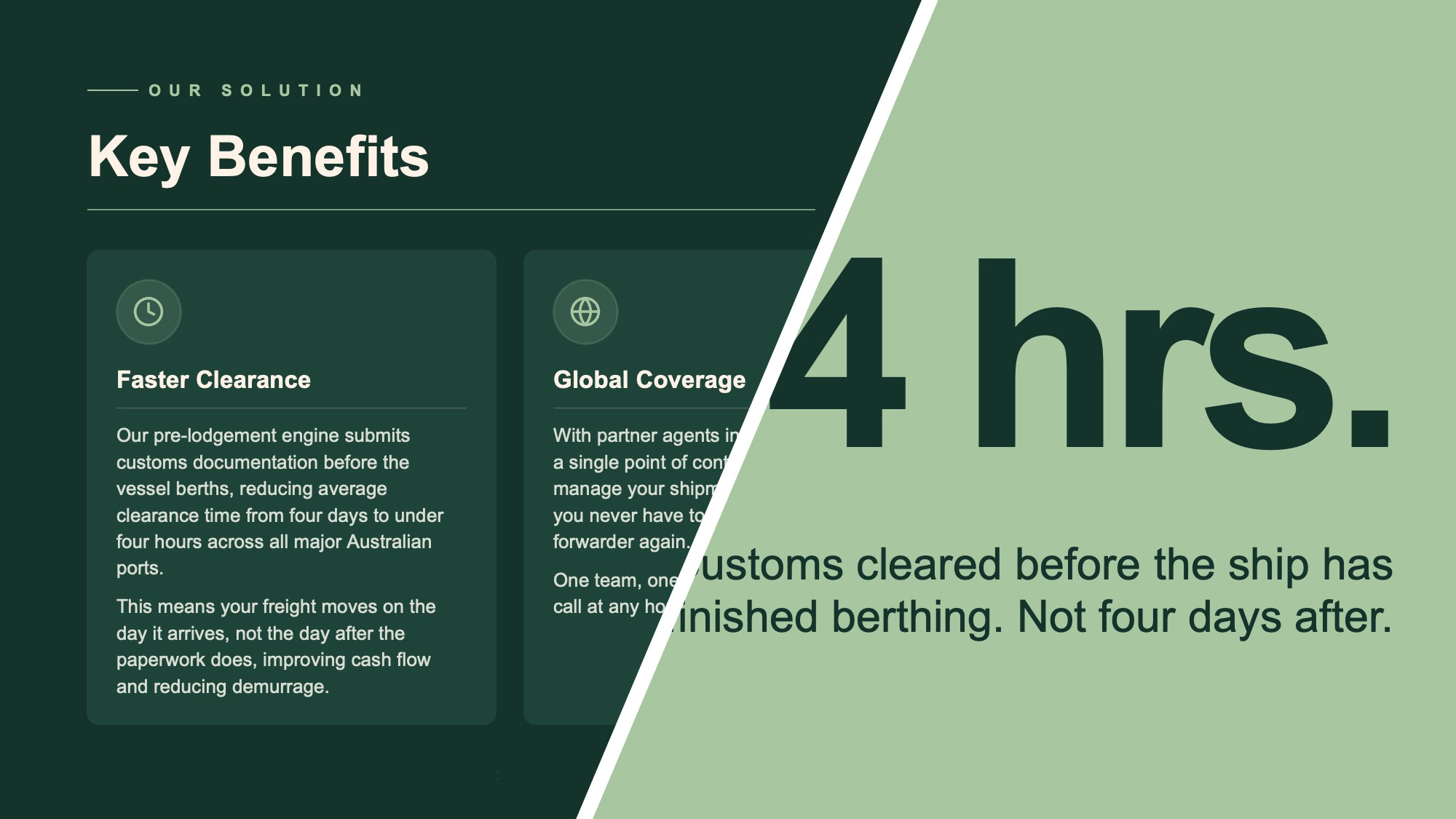
The deck lands in your inbox and it looks right. Your colours, your fonts, the logo where it should be. Then you see it: a small, letter-spaced label in all caps above the headline. OUR SOLUTION. The eyebrow.
It’s the em dash of PowerPoint. Nothing wrong with it on its own. But once you’ve seen it on a hundred AI-built slides, it tells you who made the deck, and that’s the least of its problems.
I’m not against the tools. I use them every day. But an AI-built deck has a set of habits, and once you know them you can’t unsee them. Two are harmless. Two are quietly costing you the room.
The harmless tells
Lines under the text. A thin rule beneath every heading, every column, every card. There’s nothing wrong with a rule. Designers have used them forever. But the tools use them everywhere, on every slide, at the same weight, and the result is a deck that looks ruled like an exercise book.
The eyebrow. An old newspaper trick that websites made fashionable again. On a slide it’s nearly always set too small. From the back of a boardroom it’s a smudge. In a webinar window on a laptop, it’s gone.
Neither of these hurts you on its own. What they do is tell the audience the deck was generated. And an audience that thinks the deck was generated quietly recalibrates how much thought went into everything else. Fair or not, that’s the read.
The expensive tells
The whole talk track on the slide. This is the big one. The tool has your notes, so it puts your notes on the slide. Every point, every sub-point, the transition sentences, sometimes the joke. It looks thorough. It’s a disaster in the room.
People read faster than you speak. The moment a dense slide appears, the audience reads it, finishes before you do, and waits for you to catch up. You’re no longer presenting. You’re the voiceover. And nobody remembers a voiceover.
There’s one exception. A leave-behind, the deck that gets emailed and read alone, can carry text, because nobody is talking over it. But that’s a document with slide numbers. Don’t stand up and present it.
Literal thinking. Say “growth” and you get an arrow going up and to the right. Say “global” and you get a globe. Say “our three pillars” and, sure enough, three pillars. The tool illustrates the words. What it can’t do is decide that the words shouldn’t be there at all.
Sometimes the strongest slide is one photograph and nothing else. Sometimes it’s a single number. Sometimes it’s blank, because for the next thirty seconds you want them looking at you. The tool never suggests blank. Blank doesn’t look like work.
Why it happens
A start has gravity. The tool hands you twenty finished-looking slides, and from that moment you’re editing, not thinking. You tidy slide seven. You trim a paragraph on slide twelve. You never ask whether slide twelve should exist.
The first draft becomes the ceiling. And it’s a draft that has never met your audience.
Build from the talk track
Here’s what I do, and what I ask every client to do before I touch the design.
Write the talk track first. Not bullet points. What you’d actually say, in order, as if there were no slides at all. If it doesn’t hold together as a spoken argument, no amount of design will save it.
Then go through it one beat at a time and ask a single question: what does the audience need to see while I’m saying this? Often the answer is one line. Sometimes it’s an image. Sometimes it’s a number big enough to read from the car park. And sometimes it’s nothing, because the useful thing on screen is you.
Only then build. Use the tools for the layout if you like. They’re good at it. But now they’re laying out your structure, not theirs, and the difference shows from the second slide.
Done properly, the deck is the last thing you make, not the first. Every slide has a headline that’s a full sentence and one job to do. And the thing you’re selling appears once, late, after the audience has a reason to care.
AI can give you a start. Just make sure it’s your start.